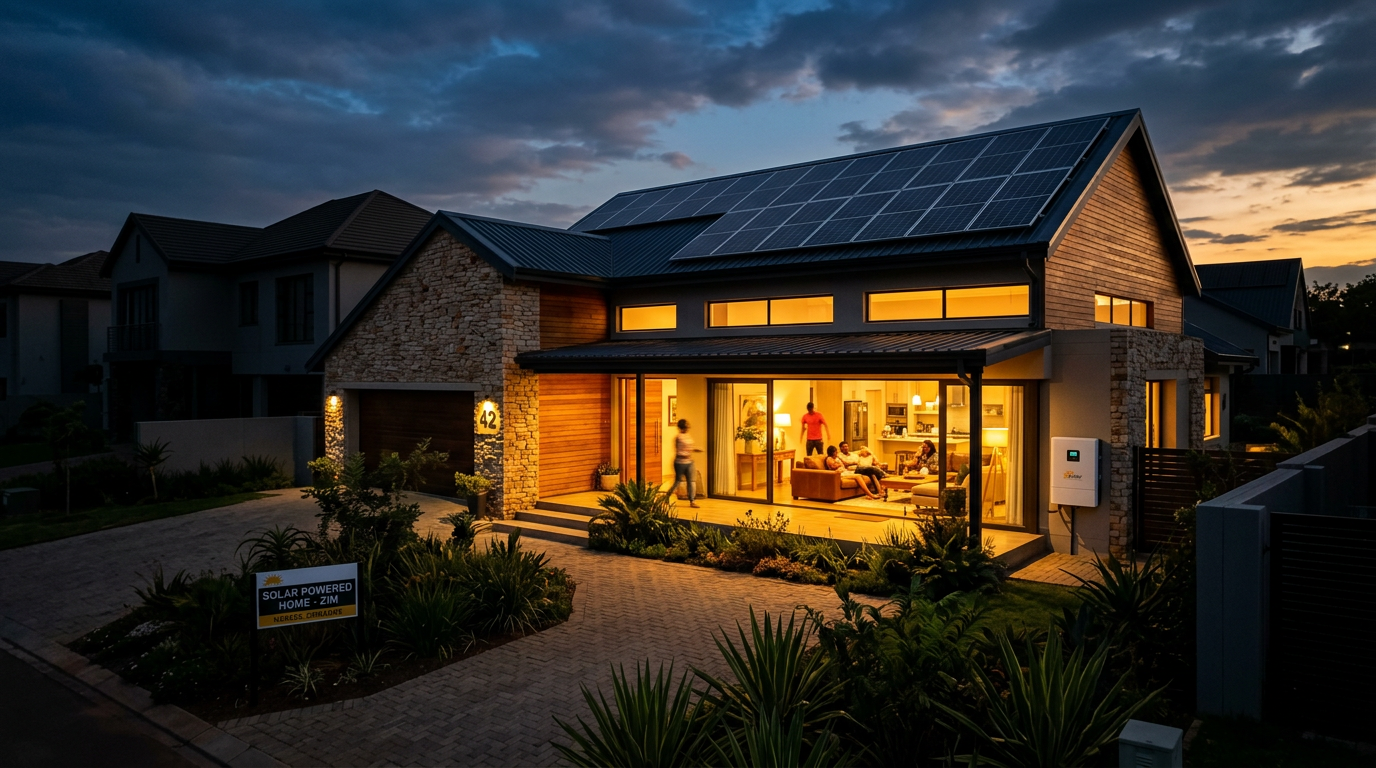
Load shedding is the number one reason people in Bulawayo are looking at solar right now. Not because they want to save the planet (though that is a bonus), but because sitting in the dark for eight hours while the meat in your freezer defrosts is not acceptable. The question is: what are your actual options, and which one makes sense for your situation?
There are three main approaches. Each has different costs, different capabilities, and different trade-offs. Let me break them down.
Option 1: Battery Backup (Inverter + Batteries, No Panels)
This is the simplest and cheapest entry point. You install an inverter and batteries. When ZESA is on, the batteries charge from the grid. When ZESA cuts out, the inverter kicks in and powers your home from the batteries.
What it costs: Roughly USD 800 to 2,500 depending on the size of the inverter and battery bank.
What it can run: Lights, TV, fridge, Wi-Fi router, phone chargers. A larger system can handle a microwave and other moderate loads. It will not run geysers, air conditioners, or stoves.
The catch: Your batteries charge from ZESA. If ZESA is off for 12 hours a day, your batteries only have 12 hours of grid power available to charge. During extended outages or Stage 4+ schedules, you might not get enough charge to last through the next outage. You are also still paying your ZESA bill because you are using grid power to charge.
Best for: People who want basic backup on a tight budget and expect load shedding to remain moderate (4-6 hours at a time).
Option 2: Hybrid Solar (Panels + Inverter + Batteries)
This is what most Bulawayo homeowners end up choosing, and for good reason. Solar panels charge your batteries during the day using free sunlight. When ZESA is on, the system can supplement or replace grid power. When ZESA cuts out, you switch to battery backup automatically.
What it costs: USD 2,500 to 7,000 for a home system, depending on size.
What it can run: Everything a battery-only system can, but with more energy available because the panels are constantly topping up the batteries. A well-sized 5kVA hybrid system handles a three-bedroom Bulawayo home comfortably.
The advantage: You are not dependent on ZESA to charge your batteries. Even during extended outages, the panels keep your batteries charged during daylight hours. And on normal days, you are using less grid power, so your electricity bill drops.
The trade-off: Higher upfront cost than battery-only. You need roof space for panels (most Bulawayo homes have plenty). The system pays for itself over time through reduced electricity bills, but the initial investment is bigger.
Best for: Homeowners who want reliable backup regardless of how bad load shedding gets, and who want to reduce their long-term electricity costs. This is the option we recommend for most Bulawayo families.
Option 3: Off-Grid Solar (Complete Independence from ZESA)
This means disconnecting from the grid entirely. Your home runs 100% on solar power and battery storage. No ZESA bill. No load shedding. Complete energy independence.
What it costs: USD 6,000 to 15,000+ for a home system. You need enough panels and batteries to cover all your energy needs, including cloudy days and evening/night usage.
What it can run: Everything, if the system is sized correctly. This includes geysers (solar-heated water is often a better option), cooking (though gas is more efficient), and all normal household appliances.
The trade-off: Highest upfront cost. Requires more batteries and panels than a hybrid system. If you undersize the system, you will run short during the rainy season when there is less sunlight. Most off-grid homes keep a generator as a backup for extended cloudy periods.
Best for: Farms, rural properties without reliable grid connection, or anyone who simply does not want to deal with ZESA at all. Less common in Bulawayo suburbs but increasingly popular on smallholdings and peri-urban properties.
What About Generators?
Generators are the traditional backup option. They work, but they come with ongoing costs that solar does not. Fuel in Bulawayo is not cheap, and a generator running for six hours a day burns through USD 5 to 15 in diesel depending on the size. That adds up to USD 150 to 450 a month. Over a year, you are spending USD 1,800 to 5,400 on fuel alone, plus maintenance and oil changes.
A 5kVA hybrid solar system costs around USD 3,000 to 5,500 once and has minimal ongoing costs. The crossover point, where solar becomes cheaper than a generator, is typically 6 to 18 months depending on your fuel usage.
Generators also make noise, produce fumes, and need regular maintenance. They have their place (especially as a backup to solar for extended cloudy periods), but as a primary load shedding solution, solar is usually the better investment.
How to Choose the Right Option
Start with two questions: how much can you spend right now, and how much backup do you need?
If your budget is under USD 2,000 and you just need lights and a fridge during four-hour outages, a battery-only system works. If you want proper whole-home backup and can invest USD 3,000 to 6,000, go hybrid. If you are on a farm or rural property without reliable ZESA, off-grid is the way.
The best move is to talk to someone who will look at your specific situation and give you honest advice. Our team does free assessments across Bulawayo. We will tell you what you need, not upsell you on what you do not.
Request a free assessment here or WhatsApp us. You can also read more about specific backup system options.